University of Delaware Athletics
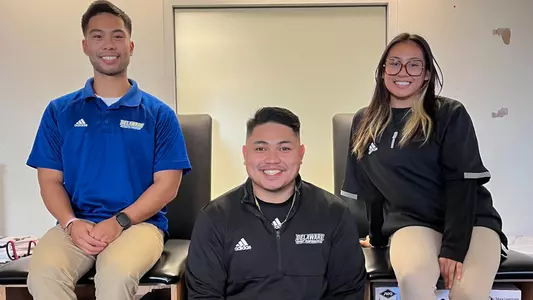
Filipino Pride Runs Deep in the Athletic Training Room of the Lil Bob
10/28/2022 1:28:00 PM
On a campus that has become more diverse over the past decade, Filipino heritage runs deep through the athletic training room at the Lil Bob.
Assistant athletic trainer Kyle Alea and his two student trainers, Kyle Ocampo and Isabella Alcaraz, all come from a Filipino background.
In October 2009, Congress officially recognized Filipino American History Month, but Alea remarked that it is something that has become increasingly celebrated locally over the past few years.
"Within the past three or five years, this is one of those things that started coming up [quickly]," Alea said. "It's good to feel recognized for it. It feels nice to have a month dedicated to the history of Filipino Americans in the United States, and I know that we all have an impact in one way or another."
In addition to all working in athletic training in the same location, all three are members of the Filipino Student Association, an organization that Alea was president of when he was an undergraduate at UD. It's an organization that is expanded its notoriety and population over the years since Alea was in school.
"Even before I came to campus, it was made known to me that FSA was a place where I could go to see familiar faces and feel included," Alcaraz said. "When I would go to class, it was obvious to me that I was the only Asian person. It wasn't such a big deal that it was as if I was treated differently, but it was nice to know that FSA was there for me to go and see familiar people."
For Ocampo and Alcaraz, working under someone who comes from the same background as them brings a different level of relatability to their work every day – something a lot of people don't get to experience.
"Health care is a common career path that a lot of Filipinos take, and most of the time that is nurse, but athletic training is a growing field for Filipinos," Ocampo said. "Having somebody who is also Filipino not only helps enhance your network in terms of who you can interact with but also opens people's eyes, especially high school students if they're thinking about what career they want to pursue. I was going to be in physical therapy, but then talking to my Filipino mentors funneled me into an athletic training status. Having a sense of family as well within Filipinos and ATs is huge."
Alea echoed a similar sentiment to Ocampo in being able to mentor two people who share his background.
"With all of us coming from similar backgrounds, it makes our relationship incredibly seamless because we know how to relate to each other on a different level than most because we've grown up in a very similar environment," Alea said. "That helps run the flow of this room significantly better as well. It's not necessarily only about Filipino stuff, but our culture is very good at being able to relate to other people and start conversations."
With the rise of notoriety came a rise in appreciation for the work they do as people, something Ocampo mentioned as one of the biggest parts of how Delaware values inclusivity as an institution.
"The way we're treated in the athletic training room is the same as others," Ocampo said. "Someone will see three Filipinos, but they don't see us as three Filipinos, we're three athletic trainers. I think that is something that hits home. We might look different, but at the end of the day, we're still athletic trainers. They treat us the same way they would treat someone else who didn't look like us. Everyone is looking at us like they look at anybody else."
While Filipino American History month wraps up in a few days, ties will remain prevalent in the athletic training room at the University of Delaware.
Assistant athletic trainer Kyle Alea and his two student trainers, Kyle Ocampo and Isabella Alcaraz, all come from a Filipino background.
In October 2009, Congress officially recognized Filipino American History Month, but Alea remarked that it is something that has become increasingly celebrated locally over the past few years.
"Within the past three or five years, this is one of those things that started coming up [quickly]," Alea said. "It's good to feel recognized for it. It feels nice to have a month dedicated to the history of Filipino Americans in the United States, and I know that we all have an impact in one way or another."
In addition to all working in athletic training in the same location, all three are members of the Filipino Student Association, an organization that Alea was president of when he was an undergraduate at UD. It's an organization that is expanded its notoriety and population over the years since Alea was in school.
"Even before I came to campus, it was made known to me that FSA was a place where I could go to see familiar faces and feel included," Alcaraz said. "When I would go to class, it was obvious to me that I was the only Asian person. It wasn't such a big deal that it was as if I was treated differently, but it was nice to know that FSA was there for me to go and see familiar people."
For Ocampo and Alcaraz, working under someone who comes from the same background as them brings a different level of relatability to their work every day – something a lot of people don't get to experience.
"Health care is a common career path that a lot of Filipinos take, and most of the time that is nurse, but athletic training is a growing field for Filipinos," Ocampo said. "Having somebody who is also Filipino not only helps enhance your network in terms of who you can interact with but also opens people's eyes, especially high school students if they're thinking about what career they want to pursue. I was going to be in physical therapy, but then talking to my Filipino mentors funneled me into an athletic training status. Having a sense of family as well within Filipinos and ATs is huge."
Alea echoed a similar sentiment to Ocampo in being able to mentor two people who share his background.
"With all of us coming from similar backgrounds, it makes our relationship incredibly seamless because we know how to relate to each other on a different level than most because we've grown up in a very similar environment," Alea said. "That helps run the flow of this room significantly better as well. It's not necessarily only about Filipino stuff, but our culture is very good at being able to relate to other people and start conversations."
With the rise of notoriety came a rise in appreciation for the work they do as people, something Ocampo mentioned as one of the biggest parts of how Delaware values inclusivity as an institution.
"The way we're treated in the athletic training room is the same as others," Ocampo said. "Someone will see three Filipinos, but they don't see us as three Filipinos, we're three athletic trainers. I think that is something that hits home. We might look different, but at the end of the day, we're still athletic trainers. They treat us the same way they would treat someone else who didn't look like us. Everyone is looking at us like they look at anybody else."
While Filipino American History month wraps up in a few days, ties will remain prevalent in the athletic training room at the University of Delaware.

Sunday, October 18
Thursday, October 15
Sunday, October 11
Saturday, October 10