University of Delaware Athletics
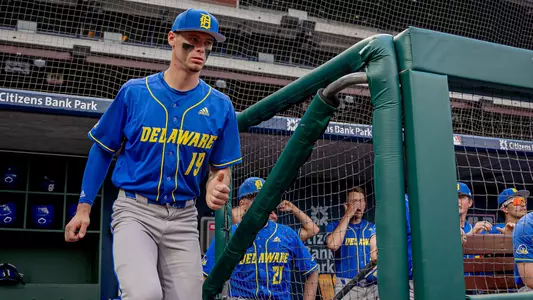
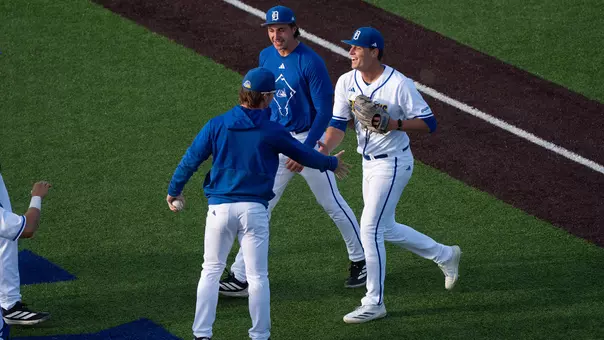
Photo by: Mikey Reeves
How Brett Lesher Became a Key Piece of Baseball's Dynamic Offense
5/21/2024 4:46:00 PM | Baseball
NEWARK, Del. – Brett Lesher is doing everything he can for the Blue Hens. The starting shortstop is holding down the fort in the field defensively, and he has really boosted the team with his bat, hitting .296 and more than doubling his offensive numbers from the year before.
What makes Lesher's story interesting is how he has no ego that gets in the way of making his team better. Unlike many with similar numbers, which make him one of the best hitters in the Hens' lineup, Lesher has been batting last all season.
Ninth.
But it has worked. The Blue Hens currently ride a 29-24 record, which includes being 16-11 against CAA opponents. The Hens finished fourth in the CAA, earning them a date against William & Mary in the CAA Tournament. Lesher's consistent bat has allowed the Blue Hens to accomplish things they otherwise would not have. This is largely due to his defense and breakout season at the plate.
For Lesher, it has always been about playing his role and being a great teammate. He has had that mentality since playing little league. The Newark, Delaware native in fact could have gone off course based on the high expectations that the closest people to him had established, albeit not intentionally.
Lesher has always had big shoes to fill, although he never consciously approached it that way. His older brother, Zach, played baseball as a Blue Hen. His mother also graduated from Delaware.
And of course, what might be the most significant factor is that Brett's father, Brian, not only played at Delaware but went on to play Major League Baseball for the Oakland Athletics, Seattle Mariners, and Toronto Blue Jays for the 1996-1998, 2000, and 2002 seasons.
As Lesher would do his entire life, he focused only on his own path and being the best baseball player he could be, regardless of the expectations that his family background created.
"From the day I was born, I had a baseball in my hand," Lesher said. "My older brother is three and a half years older than me, so I followed in his footsteps and we grew up in the backyard with our neighbors playing wiffle ball, so, really all my life I've played the game and I'm lucky enough to still be playing it."
Lesher grew up with interesting rules in his family. While "no balls in the house" might seem to be a universal policy in all households, this could not be further from the truth in the Lesher household, where throwing a ball and swinging a bat within the home was expected, according to Brian Lesher.
For Brian, it was all about getting the reps in and having a good time, no matter the setting in which batting practice took place.
"I pitched my sons pitches in our family room or dining room and let them break anything they wanted to in the house," Brian Lesher said. "We didn't really have any rules; I kind of encouraged them and would say, 'let's see what we can break today.''
Baseball was always fun for Brian, and he wanted that to be the case for Brett. So, what is not to love about hitting a screaming line drive through the kitchen off the fridge? These are still fond memories Brian Lesher holds onto and is proud of.
The six-foot, five-inch redshirt junior who now commands the starting spot at shortstop for the Blue Hens did not view his baseball path as a given. In fact, Lesher described himself as a "late bloomer," never being the biggest kid on his team.
With a slower growth rate than his peers, Lesher leaned on his immediate support group for guidance during his early high school days, looking to his brother's collegiate recruitment process during Brett's sophomore year to help him believe he could get to that level as well. His father also instilled in him the belief that he could compete with anyone, which Brett refers to today as a big motivator and a significant reason he has achieved as much as he has playing baseball.
Of course, it would also help that Lesher would grow physically in the middle of high school. It was that final factor that pushed him to really take his baseball seriously.
It was not until his junior year in which he blossomed into an athlete… in basketball. Brian Lesher remembers Brett coming down the court and dunking on fast break. The accomplishment was dramatic, since the previous year he was not able to touch the rim.
"The kid always worked hard; he definitely had a passion and drive to be the best he could be," Brian Lesher said. "That's definitely what's taken him to where he is now."
He had always dreamed of playing for the Blue Hens. The hometown kid had all of his roots in Newark. There was his father's legacy and his mother having graduated from UD. His brother also played at Delaware, and Lesher grew up going to the baseball camps and baseball games as a kid.
He liked the atmosphere, he enjoyed the family ties, and he loved that Delaware would provide him a chance to continue playing at a high level.
"I had a conversation with Coach Sherman [his previous baseball coach at Delaware], and he ended up telling me I'd have the opportunity to play here, and I really couldn't pass that up."
Current Delaware baseball head coach Greg Mamula believes Lesher carries his ties to the university and town well. He notices his parents are at every game, as well as his grandparents.
"That's the neat thing about college athletics, when you stay close to home, you get to share your experience with your family," Mamula said.
But Lesher still had to wait his turn. He ended up redshirting his freshman year. As Lesher had to work to make the varsity team in high school, he would have to do the same in college. He did not appear in any games during his first year.
His mindset remained the same: earn what was not given to him. In this case, it was an everyday spot in the Blue Hens lineup. This theme stayed with Lesher throughout each stage of his baseball journey. Little would he realize at the time that he would eventually be able to check off each hurdle and excel each step of the way.
"I knew that if I just put in the work over time and trusted the process of developing, eventually I'd get my turn… no matter where that would be, so I just had to stay patient and wait for that opportunity," Lesher said.
Again, this idea of being a team player was part of Lesher since the beginning. And he meant it. It shows in the fact that the Blue Hen with the highest batting average on the team does not mind batting last in the lineup. The attitude stayed with him even four years after he concluded that he would have a flexible mindset to best serve the team.
Slowly, Lesher made progress. During his redshirt-sophomore year, he would get into game action. He played in 12 games and even started two of them. That 2022 season for Lesher would be beneficial, even if he just got his feet wet. In the 12 games, he would record three hits on 11 at bats, hit one home run, drive in four runs, walk three times, and have an on-base percentage of .467 to go along with his .273 batting average.
This was a brief introduction to college ball but a productive one, and an experience Lesher would use to fuel his efforts to play more regularly going forward.
In 2023, the big jump occurred after Mamula moved Lesher to right field so Freeman could stay at shortstop. The move worked well and Lesher made the best of it. He appeared in 47 games and started in 40. At the plate he would bat .234, making 34 hits in 145 at bats. Lesher added some power, finishing with three home runs and recording 19 RBIs. As a newly positioned right fielder he had 81 put outs, two assists, and a .988 fielding percentage. Impressive numbers, especially for the first-time right fielder.
Experience and development are what Lesher cites as fueling the jump from his freshman to sophomore seasons. It was the work he put in during the offseason that helped him become the player he is now. He spent a lot of time on the practice field in the offseason and went to the weight rooms to get "bigger and stronger," in preparation for his next season.
Lesher has put everything together this season. He has started in forty-one of the forty-six games he has played. He is batting .296, and hit as high as .308. He has seven home runs and 43 RBIs. His fielding percentage at shortstop is .957 and he has recorded 143 assists. And that is even after what Lesher calls a slow start.
Brett Lesher's trajectory was not always this high. He worked at it and struggled. For Brian Lesher, it has been a genuine roller coaster with ups and downs. Fortunately, while baseball is a difficult sport, Brian Lesher feels as though Brett figured the sport out prior to college. He mentioned that so many kids stop after little league due to the significantly larger dimensions of the field after.
"When you're 13 years old and jumping on a big field, those homeruns in little league are flyball outs on the big field," Brian Lesher said. "He knew if he could just hang in there a few more years he would have a little bit more success on the big field."
The stats certainly jump out at Mamula, but he is not surprised. He knew Lesher had it in him to perform successfully in the field and at the plate. It was just a matter of getting him the reps and solidifying a regular role for him.
"He has made a lot of good plays at shortstop for us this year," Mamula said. "Everyone within the program knew what he was capable of, he was our best hitter this fall, and he has really showed it this year with a lot of clutch hits, a lot of doubles and RBIs for us."
Mamula entered the scene as coach during Lesher's second year at UD. Mamula already had plans at shortstop; JJ Freeman was a redshirt-senior who led the conference in assists at shortstop during his redshirt-junior year.
"His defensive skills jumped out at me right away," Mamula said. "As things worked out last year, it just worked best that JJ play short and Lesh play right field for us."
Right field, not shortstop. But that was all fine given Lesher's attitude and approach. Wherever he was needed, he would play. During his redshirt sophomore year, playing regularly meant he would have to play right field. He did, and he did not care.
Another part of Lesher's approach to baseball involves being very coachable. He built a strong relationship with the Blue Hens previous coach, Jim Sherman, who retired at the conclusion of the 2022 season. In walked Mamula, and Lesher would have to show him he was capable of having a daily impact on the team. He would have to adjust.
Mamula would notice, and Lesher has played in the last ninety-one games Mamula has managed, starting in 81 of those games.
"Mams has been great, I really love him," Lesher said. "I think he gives us the confidence to go into games and just play the way we know we are able to."
But again, it all started from Lesher's approach as a young ball player. Be available for any opportunity, regardless of whether it was his ideal situation. With his placement at his natural position at shortstop this season, everything from April on has been smooth. His defensive play has remained stellar, but it has been his production at the plate that has really stood out in his breakout season.
"I just try to never get too high or too low," Lesher said. "I always trusted myself and my abilities and know that I am going to figure it out."
What most helped Lesher emerge as the hitter he has become? Interestingly enough, he attributes that success to not worrying about his stats. Rather, he just embraces every situation he is in, such as putting an emphasis on hitting runners in from scoring position. Embracing the opportunity, rather than worry about every statistical aspect at play when he bats.
It also might have helped Brett that his father had a professional baseball mind, and tried to instill professional hitting concepts at an early age. Brian Lesher had a front row seat in learning how to be a better hitter from guys like Mark McGwire, Alex Rodriguez, Jason Giambi, and Edgar Martinez. He would teach their approach to hitting for Brett, specifically focusing on one specific hitting concept.
"When he was in little league, I preached opposite field hitting," Brian Lesher said. "If you could hit opposite field, your mechanics in your swing are usually on; a lot of good things happen, you start using the entire field."
Brian Lesher attributes Brett's near.300 batting average this season to his ability to hit opposite field, while also being able to mix it up and pull the ball as well.
Being a team player comes second nature to Lesher. While he was batting north of .300 late in the season and could bat leadoff, he has accepted his role in batting ninth in the lineup all season, even after a historically strong April at the plate.
It is out of his control where he hits, but what is in his control is how he plays. So, for him, the ability to start every game at short and still get at least three at bats a game is beyond good enough.
Which also translates to being good for the team. The Blue Hens have at a time had a.300 plus hitter at the end of their lineup, which helps the Hens win. That is all Lesher needed to see.
"With the lineup we have, really anyone one through nine could hit in any position," Lesher said. "I am glad that I can round out the lineup at the bottom, and I'm just trying to do my part just like everyone else is."
Most importantly, Mamula likes where Lesher bats because it works. He is not invested in making unnecessary changes, and neither is Lesher. They both know that his role batting ninth has helped the Blue Hens win, which is the only thing they are concerned about.
"It's working, our offense is clicking," Mamula said. "There is no reason to move him out of there since he is producing so well out of that spot.
It is a very lunch-pail mentality. Lesher shows up, plays wherever he is told to better the team, and gets the job done. He does not feel forced to play baseball either. Even with his father's deep connection with the sport and his brother's baseball career at Delaware, Brian Lesher always told Brett that "there was more to life than baseball."
It's personal for Brian Lesher. Yes, of course Brett is his son and that evokes a lot of the emotion and pride Brian has for his son. But Brian also saw everything from the start-- he was Brett's coach since day one, from tee ball to high school. He did it not to add pressure from a former major league baseball player's perspective, but because it was fun, and it was fun to be close with Brett throughout his life's journey with the sport at an early age. So, Brian was able to use his wealth of knowledge in the sport which Brett participated in throughout his little league experience.
"I did it because I had fun and had a great time with Brett on the field," Brian Lesher said. "They picked the path they wanted to pick, but with my knowledge and experience of the game, it was kind of my duty to give back to the community and pass that knowledge and experience on."
Not a bad resource for youth ball players in the Newark area to learn from in the 2010s, to say the least.
Baseball has been vital for Brett, but even Brian Lesher knows it is not everything. While he is happy about how nourishing the sport has been for his son, he is most proud of the person he has become through the sport. The playing time is nice, the stats are great, but what Brett has gained as a result of playing baseball is the true victory, according to Brian Lesher.
"Baseball is just a game, so I don't put too much into how they do on the field," Brian Lesher said. "I'm happy for him, but I'm more happy about the person he is and the friends he has and the love he has for all his friends and family."
Lesher's team-first approach to baseball, from wiffleball in the backyard to Bob Hannah Stadium at the University of Delaware, has really help solidify him as a ball player. He can be relied upon to do whatever he has to help the team. He took on the mindset at an early age, and has seen the benefits it has had in getting him into lineups.
But even Lesher might not realize the impact he has had on the 2024 Blue Hens team. When asked about where the team would be if Lesher were not playing for the Hens, Mamula gave a telling response.
"We certainly would not be having the season we're having and that's for sure," Mamula said. "We would not have as many wins, we would not be playing nearly as good defense, we would not be swinging the bat as well, and from a culture standpoint, we would be missing one of our cornerstones with team leadership and how he goes about his business every single day."
What makes Lesher's story interesting is how he has no ego that gets in the way of making his team better. Unlike many with similar numbers, which make him one of the best hitters in the Hens' lineup, Lesher has been batting last all season.
Ninth.
But it has worked. The Blue Hens currently ride a 29-24 record, which includes being 16-11 against CAA opponents. The Hens finished fourth in the CAA, earning them a date against William & Mary in the CAA Tournament. Lesher's consistent bat has allowed the Blue Hens to accomplish things they otherwise would not have. This is largely due to his defense and breakout season at the plate.
For Lesher, it has always been about playing his role and being a great teammate. He has had that mentality since playing little league. The Newark, Delaware native in fact could have gone off course based on the high expectations that the closest people to him had established, albeit not intentionally.
Lesher has always had big shoes to fill, although he never consciously approached it that way. His older brother, Zach, played baseball as a Blue Hen. His mother also graduated from Delaware.
And of course, what might be the most significant factor is that Brett's father, Brian, not only played at Delaware but went on to play Major League Baseball for the Oakland Athletics, Seattle Mariners, and Toronto Blue Jays for the 1996-1998, 2000, and 2002 seasons.
As Lesher would do his entire life, he focused only on his own path and being the best baseball player he could be, regardless of the expectations that his family background created.
"From the day I was born, I had a baseball in my hand," Lesher said. "My older brother is three and a half years older than me, so I followed in his footsteps and we grew up in the backyard with our neighbors playing wiffle ball, so, really all my life I've played the game and I'm lucky enough to still be playing it."
Lesher grew up with interesting rules in his family. While "no balls in the house" might seem to be a universal policy in all households, this could not be further from the truth in the Lesher household, where throwing a ball and swinging a bat within the home was expected, according to Brian Lesher.
For Brian, it was all about getting the reps in and having a good time, no matter the setting in which batting practice took place.
"I pitched my sons pitches in our family room or dining room and let them break anything they wanted to in the house," Brian Lesher said. "We didn't really have any rules; I kind of encouraged them and would say, 'let's see what we can break today.''
Baseball was always fun for Brian, and he wanted that to be the case for Brett. So, what is not to love about hitting a screaming line drive through the kitchen off the fridge? These are still fond memories Brian Lesher holds onto and is proud of.
The six-foot, five-inch redshirt junior who now commands the starting spot at shortstop for the Blue Hens did not view his baseball path as a given. In fact, Lesher described himself as a "late bloomer," never being the biggest kid on his team.
With a slower growth rate than his peers, Lesher leaned on his immediate support group for guidance during his early high school days, looking to his brother's collegiate recruitment process during Brett's sophomore year to help him believe he could get to that level as well. His father also instilled in him the belief that he could compete with anyone, which Brett refers to today as a big motivator and a significant reason he has achieved as much as he has playing baseball.
Of course, it would also help that Lesher would grow physically in the middle of high school. It was that final factor that pushed him to really take his baseball seriously.
It was not until his junior year in which he blossomed into an athlete… in basketball. Brian Lesher remembers Brett coming down the court and dunking on fast break. The accomplishment was dramatic, since the previous year he was not able to touch the rim.
"The kid always worked hard; he definitely had a passion and drive to be the best he could be," Brian Lesher said. "That's definitely what's taken him to where he is now."
He had always dreamed of playing for the Blue Hens. The hometown kid had all of his roots in Newark. There was his father's legacy and his mother having graduated from UD. His brother also played at Delaware, and Lesher grew up going to the baseball camps and baseball games as a kid.
He liked the atmosphere, he enjoyed the family ties, and he loved that Delaware would provide him a chance to continue playing at a high level.
"I had a conversation with Coach Sherman [his previous baseball coach at Delaware], and he ended up telling me I'd have the opportunity to play here, and I really couldn't pass that up."
Current Delaware baseball head coach Greg Mamula believes Lesher carries his ties to the university and town well. He notices his parents are at every game, as well as his grandparents.
"That's the neat thing about college athletics, when you stay close to home, you get to share your experience with your family," Mamula said.
But Lesher still had to wait his turn. He ended up redshirting his freshman year. As Lesher had to work to make the varsity team in high school, he would have to do the same in college. He did not appear in any games during his first year.
His mindset remained the same: earn what was not given to him. In this case, it was an everyday spot in the Blue Hens lineup. This theme stayed with Lesher throughout each stage of his baseball journey. Little would he realize at the time that he would eventually be able to check off each hurdle and excel each step of the way.
"I knew that if I just put in the work over time and trusted the process of developing, eventually I'd get my turn… no matter where that would be, so I just had to stay patient and wait for that opportunity," Lesher said.
Again, this idea of being a team player was part of Lesher since the beginning. And he meant it. It shows in the fact that the Blue Hen with the highest batting average on the team does not mind batting last in the lineup. The attitude stayed with him even four years after he concluded that he would have a flexible mindset to best serve the team.
Slowly, Lesher made progress. During his redshirt-sophomore year, he would get into game action. He played in 12 games and even started two of them. That 2022 season for Lesher would be beneficial, even if he just got his feet wet. In the 12 games, he would record three hits on 11 at bats, hit one home run, drive in four runs, walk three times, and have an on-base percentage of .467 to go along with his .273 batting average.
This was a brief introduction to college ball but a productive one, and an experience Lesher would use to fuel his efforts to play more regularly going forward.
In 2023, the big jump occurred after Mamula moved Lesher to right field so Freeman could stay at shortstop. The move worked well and Lesher made the best of it. He appeared in 47 games and started in 40. At the plate he would bat .234, making 34 hits in 145 at bats. Lesher added some power, finishing with three home runs and recording 19 RBIs. As a newly positioned right fielder he had 81 put outs, two assists, and a .988 fielding percentage. Impressive numbers, especially for the first-time right fielder.
Experience and development are what Lesher cites as fueling the jump from his freshman to sophomore seasons. It was the work he put in during the offseason that helped him become the player he is now. He spent a lot of time on the practice field in the offseason and went to the weight rooms to get "bigger and stronger," in preparation for his next season.
Lesher has put everything together this season. He has started in forty-one of the forty-six games he has played. He is batting .296, and hit as high as .308. He has seven home runs and 43 RBIs. His fielding percentage at shortstop is .957 and he has recorded 143 assists. And that is even after what Lesher calls a slow start.
Brett Lesher's trajectory was not always this high. He worked at it and struggled. For Brian Lesher, it has been a genuine roller coaster with ups and downs. Fortunately, while baseball is a difficult sport, Brian Lesher feels as though Brett figured the sport out prior to college. He mentioned that so many kids stop after little league due to the significantly larger dimensions of the field after.
"When you're 13 years old and jumping on a big field, those homeruns in little league are flyball outs on the big field," Brian Lesher said. "He knew if he could just hang in there a few more years he would have a little bit more success on the big field."
The stats certainly jump out at Mamula, but he is not surprised. He knew Lesher had it in him to perform successfully in the field and at the plate. It was just a matter of getting him the reps and solidifying a regular role for him.
"He has made a lot of good plays at shortstop for us this year," Mamula said. "Everyone within the program knew what he was capable of, he was our best hitter this fall, and he has really showed it this year with a lot of clutch hits, a lot of doubles and RBIs for us."
Mamula entered the scene as coach during Lesher's second year at UD. Mamula already had plans at shortstop; JJ Freeman was a redshirt-senior who led the conference in assists at shortstop during his redshirt-junior year.
"His defensive skills jumped out at me right away," Mamula said. "As things worked out last year, it just worked best that JJ play short and Lesh play right field for us."
Right field, not shortstop. But that was all fine given Lesher's attitude and approach. Wherever he was needed, he would play. During his redshirt sophomore year, playing regularly meant he would have to play right field. He did, and he did not care.
Another part of Lesher's approach to baseball involves being very coachable. He built a strong relationship with the Blue Hens previous coach, Jim Sherman, who retired at the conclusion of the 2022 season. In walked Mamula, and Lesher would have to show him he was capable of having a daily impact on the team. He would have to adjust.
Mamula would notice, and Lesher has played in the last ninety-one games Mamula has managed, starting in 81 of those games.
"Mams has been great, I really love him," Lesher said. "I think he gives us the confidence to go into games and just play the way we know we are able to."
But again, it all started from Lesher's approach as a young ball player. Be available for any opportunity, regardless of whether it was his ideal situation. With his placement at his natural position at shortstop this season, everything from April on has been smooth. His defensive play has remained stellar, but it has been his production at the plate that has really stood out in his breakout season.
"I just try to never get too high or too low," Lesher said. "I always trusted myself and my abilities and know that I am going to figure it out."
What most helped Lesher emerge as the hitter he has become? Interestingly enough, he attributes that success to not worrying about his stats. Rather, he just embraces every situation he is in, such as putting an emphasis on hitting runners in from scoring position. Embracing the opportunity, rather than worry about every statistical aspect at play when he bats.
It also might have helped Brett that his father had a professional baseball mind, and tried to instill professional hitting concepts at an early age. Brian Lesher had a front row seat in learning how to be a better hitter from guys like Mark McGwire, Alex Rodriguez, Jason Giambi, and Edgar Martinez. He would teach their approach to hitting for Brett, specifically focusing on one specific hitting concept.
"When he was in little league, I preached opposite field hitting," Brian Lesher said. "If you could hit opposite field, your mechanics in your swing are usually on; a lot of good things happen, you start using the entire field."
Brian Lesher attributes Brett's near.300 batting average this season to his ability to hit opposite field, while also being able to mix it up and pull the ball as well.
Being a team player comes second nature to Lesher. While he was batting north of .300 late in the season and could bat leadoff, he has accepted his role in batting ninth in the lineup all season, even after a historically strong April at the plate.
It is out of his control where he hits, but what is in his control is how he plays. So, for him, the ability to start every game at short and still get at least three at bats a game is beyond good enough.
Which also translates to being good for the team. The Blue Hens have at a time had a.300 plus hitter at the end of their lineup, which helps the Hens win. That is all Lesher needed to see.
"With the lineup we have, really anyone one through nine could hit in any position," Lesher said. "I am glad that I can round out the lineup at the bottom, and I'm just trying to do my part just like everyone else is."
Most importantly, Mamula likes where Lesher bats because it works. He is not invested in making unnecessary changes, and neither is Lesher. They both know that his role batting ninth has helped the Blue Hens win, which is the only thing they are concerned about.
"It's working, our offense is clicking," Mamula said. "There is no reason to move him out of there since he is producing so well out of that spot.
It is a very lunch-pail mentality. Lesher shows up, plays wherever he is told to better the team, and gets the job done. He does not feel forced to play baseball either. Even with his father's deep connection with the sport and his brother's baseball career at Delaware, Brian Lesher always told Brett that "there was more to life than baseball."
It's personal for Brian Lesher. Yes, of course Brett is his son and that evokes a lot of the emotion and pride Brian has for his son. But Brian also saw everything from the start-- he was Brett's coach since day one, from tee ball to high school. He did it not to add pressure from a former major league baseball player's perspective, but because it was fun, and it was fun to be close with Brett throughout his life's journey with the sport at an early age. So, Brian was able to use his wealth of knowledge in the sport which Brett participated in throughout his little league experience.
"I did it because I had fun and had a great time with Brett on the field," Brian Lesher said. "They picked the path they wanted to pick, but with my knowledge and experience of the game, it was kind of my duty to give back to the community and pass that knowledge and experience on."
Not a bad resource for youth ball players in the Newark area to learn from in the 2010s, to say the least.
Baseball has been vital for Brett, but even Brian Lesher knows it is not everything. While he is happy about how nourishing the sport has been for his son, he is most proud of the person he has become through the sport. The playing time is nice, the stats are great, but what Brett has gained as a result of playing baseball is the true victory, according to Brian Lesher.
"Baseball is just a game, so I don't put too much into how they do on the field," Brian Lesher said. "I'm happy for him, but I'm more happy about the person he is and the friends he has and the love he has for all his friends and family."
Lesher's team-first approach to baseball, from wiffleball in the backyard to Bob Hannah Stadium at the University of Delaware, has really help solidify him as a ball player. He can be relied upon to do whatever he has to help the team. He took on the mindset at an early age, and has seen the benefits it has had in getting him into lineups.
But even Lesher might not realize the impact he has had on the 2024 Blue Hens team. When asked about where the team would be if Lesher were not playing for the Hens, Mamula gave a telling response.
"We certainly would not be having the season we're having and that's for sure," Mamula said. "We would not have as many wins, we would not be playing nearly as good defense, we would not be swinging the bat as well, and from a culture standpoint, we would be missing one of our cornerstones with team leadership and how he goes about his business every single day."
Players Mentioned

INF
/ Baseball
INF
/ BaseballThursday, June 15
Wednesday, April 26
Tuesday, April 04
Tuesday, March 14