University of Delaware Athletics
Hanna Garber Leads Delaware's Sprint Around The Bases
4/23/2019 1:47:00 PM | Softball
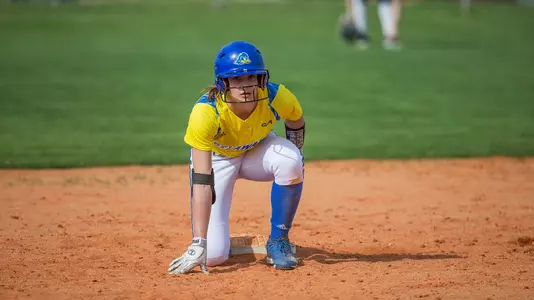
It looks strange at first, as if a track meet suddenly broke out on the base paths of the Delaware Softball Diamond.
As soon as a Blue Hen reaches base, she drops down into a three-point stance, similar to how sprinters line up in the blocks for a 100-meter dash or a defensive lineman prepares to rush the quarterback.
"At first it was really weird. We were a little skeptical, not going to lie," freshman center fielder Hanna Garber said. "Once we realized how much stronger we came off the base and how much faster we could get places, I think we all really bought into it."

At the first read of an off-speed pitch or a throw in the dirt, Garber explodes out of the sprinter's stance to beat the throw to second base. The Lancaster, Pa., native is in second in the Colonial Athletic Association with 24 stolen bases this season, which is among the top 30 in Division I.
Garber and fellow freshmen Halle Kisamore and Brittney Mendoza are all in the top five in the conference in stolen bases, highlighting the aggressive offensive philosophy head coach Jen Steele has implemented in her first year at the helm of Delaware softball.
The Blue Hens are by far the conference leader in steals (81), swiping more bags than most other CAA team has even attempted to steal. Garber individually has more stolen bases than Charleston and Elon have as entire teams.

Steele has developed the aggressive baserunning strategy as she's evolved as a head coach across stops at Marshall, Jacksonville and Randolph (DIII).
"It definitely is now, I would say that I haven't always coached that way," Steele said of her philosophy of aggressively running. "I've studied a lot of metrics, probabilities and percentages of scoring runs and what decisions you should make and when…Statistics show that if you have a runner at second base with one out, your percentage of scoring a run is a lot lower than if you have a runner at first base and no outs."
That preference to steal instead of moving runners over with a sacrifice bunt is bolstered by how difficult it is for catchers to throw out would-be base stealers.
"If they're throwing them out 30-40% of the time, those catchers are doing a really good job. If, at max, they're successful 40% of the time, then 60% of the time they're failing," Steele said. "If you could be safe 70% of the time when you're stealing bases, you need to go because you're going to generate X more amount of runs for your team long term. That is something where we've been more successful."
Garber, a three-sport athlete in high school, bats at the top of the Blue Hens' lineup, where her athleticism spearheads the Delaware offense. Steele and her staff have worked with her to develop a sense of when to read opportunities to steal instead of relying on signs from the dugout.
"She is still learning, she has so much raw ability," Steele said of her young center fielder. "The fact that we have a kid that's a freshman that's learned this much already, she has three more years, is pretty promising."

Kisamore generally bats behind Garber in the two hole, and has a mindset perfectly molded for Steele's system.
"She is a kid that sees red. She wants to hit the ball as hard as possible, she wants to steal all the bases, she wants to dive for all the plays," Steele said. "She's got pretty good foot speed and she's not afraid of contact so she goes in pretty hard at bases. I would say at least two or three of her steals so far, she's been able to go in hard, the defender has been in her way and she's won the battle because she's a pretty tough athlete."
The Blue Hens have been thrown out 20 times this year attempting to steal bases, but they're willing to accept aggressive mistakes knowing the impact their threat of stealing has on the game. Even if it doesn't always manifest in a steal, pressing the issue on the base paths results in extra bases and extra runs by changing the way opposing defenses play.
"I definitely think we make teams very, very uneasy," Steele said. "The middle [infielders] are always pinched, they open up big spots on the field for us. They're so concerned about what we're going to do that the pitcher starts muffing pitches at times and our walks have gone up. The more focus we can put on us, and we can make them worry about us, we know that they're not focusing on their own execution and they're going to mess up; they're going to miss at some point."
Possibly the most important aspect of the strategy is how much it energizes the Blue Hens.
"It's so much fun sliding in safe, getting up and you're like 'Ha! I'm one step closer, one base closer,'" Garber said. "The dugout just erupts, which is really cool."
As soon as a Blue Hen reaches base, she drops down into a three-point stance, similar to how sprinters line up in the blocks for a 100-meter dash or a defensive lineman prepares to rush the quarterback.
"At first it was really weird. We were a little skeptical, not going to lie," freshman center fielder Hanna Garber said. "Once we realized how much stronger we came off the base and how much faster we could get places, I think we all really bought into it."
At the first read of an off-speed pitch or a throw in the dirt, Garber explodes out of the sprinter's stance to beat the throw to second base. The Lancaster, Pa., native is in second in the Colonial Athletic Association with 24 stolen bases this season, which is among the top 30 in Division I.
Garber and fellow freshmen Halle Kisamore and Brittney Mendoza are all in the top five in the conference in stolen bases, highlighting the aggressive offensive philosophy head coach Jen Steele has implemented in her first year at the helm of Delaware softball.
The Blue Hens are by far the conference leader in steals (81), swiping more bags than most other CAA team has even attempted to steal. Garber individually has more stolen bases than Charleston and Elon have as entire teams.
Steele has developed the aggressive baserunning strategy as she's evolved as a head coach across stops at Marshall, Jacksonville and Randolph (DIII).
"It definitely is now, I would say that I haven't always coached that way," Steele said of her philosophy of aggressively running. "I've studied a lot of metrics, probabilities and percentages of scoring runs and what decisions you should make and when…Statistics show that if you have a runner at second base with one out, your percentage of scoring a run is a lot lower than if you have a runner at first base and no outs."
That preference to steal instead of moving runners over with a sacrifice bunt is bolstered by how difficult it is for catchers to throw out would-be base stealers.
"If they're throwing them out 30-40% of the time, those catchers are doing a really good job. If, at max, they're successful 40% of the time, then 60% of the time they're failing," Steele said. "If you could be safe 70% of the time when you're stealing bases, you need to go because you're going to generate X more amount of runs for your team long term. That is something where we've been more successful."
Garber, a three-sport athlete in high school, bats at the top of the Blue Hens' lineup, where her athleticism spearheads the Delaware offense. Steele and her staff have worked with her to develop a sense of when to read opportunities to steal instead of relying on signs from the dugout.
"She is still learning, she has so much raw ability," Steele said of her young center fielder. "The fact that we have a kid that's a freshman that's learned this much already, she has three more years, is pretty promising."
Kisamore generally bats behind Garber in the two hole, and has a mindset perfectly molded for Steele's system.
"She is a kid that sees red. She wants to hit the ball as hard as possible, she wants to steal all the bases, she wants to dive for all the plays," Steele said. "She's got pretty good foot speed and she's not afraid of contact so she goes in pretty hard at bases. I would say at least two or three of her steals so far, she's been able to go in hard, the defender has been in her way and she's won the battle because she's a pretty tough athlete."
The Blue Hens have been thrown out 20 times this year attempting to steal bases, but they're willing to accept aggressive mistakes knowing the impact their threat of stealing has on the game. Even if it doesn't always manifest in a steal, pressing the issue on the base paths results in extra bases and extra runs by changing the way opposing defenses play.
"I definitely think we make teams very, very uneasy," Steele said. "The middle [infielders] are always pinched, they open up big spots on the field for us. They're so concerned about what we're going to do that the pitcher starts muffing pitches at times and our walks have gone up. The more focus we can put on us, and we can make them worry about us, we know that they're not focusing on their own execution and they're going to mess up; they're going to miss at some point."
Possibly the most important aspect of the strategy is how much it energizes the Blue Hens.
"It's so much fun sliding in safe, getting up and you're like 'Ha! I'm one step closer, one base closer,'" Garber said. "The dugout just erupts, which is really cool."




Players Mentioned


Monday, June 03
Monday, May 06
Monday, April 15
Saturday, March 30