University of Delaware Athletics
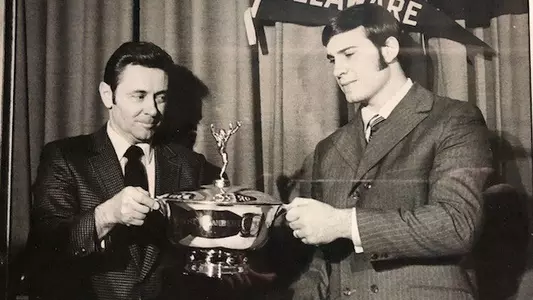
1970 Football Wins Lambert Cup, Boardwalk Bowl
12/21/2020 10:00:00 AM | Football
Legendary Delaware football coach Tubby Raymond was notorious for his creative methods of motivating his players. This was a trend that started early in his 36-year tenure at the helm of the Blue Hens.
Before he eventually won 300 career games, Delaware went 2-7 during Raymond's second year as head coach in 1967. Determined to inspire his players not to let that happen again, Raymond spliced together the film of the final game of that season, a 35-6 loss at Bucknell, and had the footage of future Super Bowl champion Sam Havrilak running over the Blue Hens defense playing on a loop as the Delaware players entered the locker room for spring practice in 1968.
Entering that locker room that spring was a class of rising sophomores that, after an undefeated freshmen football season the fall prior (freshmen could not compete on varsity teams during this era), were ready to make their mark on the Blue Hens program. Chief among them on the defensive side of the ball were Ray Holcomb, a sturdy linebacker, Ron Klein, a speedy and athletic cornerback who also played in the College World Series with Delaware baseball, and Pete Sundheim, a hard-hitting safety.
By the end of the 1968 season, sophomores filled eight of the starting positions on defense and the Blue Hens returned to winning ways, claiming the Mid-Atlantic Conference championship, the Lambert Cup, and the Boardwalk Bowl with an 8-3 record.
Fifty years ago this fall, that group finished their playing careers as seniors with three consecutive Lambert Cups, three consecutive Boardwalk Bowl victories, and a career record of 26-7.
The team elected Holcomb as captain for the 1970 season, the first year as an independent for the Blue Hens after leaving the MAC.
"I was an average guy. I loved the game to death; I loved it. It was my life. And I played way above my capability," a modest Holcomb said on a Zoom call this past week.
"Yeah, but you're tough as nails too," his teammate Sundheim chimed in. "Not only tough as nails physically, but mentally."
According to Holcomb, the strength of the defense was the secondary, where Sundheim, Klein and safety Bruce Fad roamed and combined for 14 of the team's 24 interceptions on the year. Dennis Johnson and Ted Gregory, who each went on to be NFL Draft picks, spearheaded the defensive line with 74 and 72 tackles, respectively.
Alongside Holcomb at linebacker was Ron Whittington, a speedy junior from New Castle, Del.
"The defense was strong because we had guys like Gregory and Johnson; these guys were all like lightning," Whittington said. "That was probably the thing that made our team strong: very, very strong caliber players."
On the other side of the ball, the Blue Hens stayed true to their trademark Delaware Wing-T offense. The style relied heavily on counters and misdirection, which meant that compared to a traditional offensive line, Delaware's linemen were small and quick to fit the elaborate blocking schemes. The star of the line was All-American right guard Conway Hayman who was the big presence at 6-foot-3 and 250 pounds.
While the Wing-T doesn't necessarily have to be a run-dominant system, the 1970 iteration of the Blue Hens found their success on the ground. The backfield of Chuck Hall, Bill Armstrong, Gardy Kahoe, and Dick Kelly was dubbed "The Four Horsemen," with each member rushing for over 500 yards that season. The Blue Hens regularly racked up over 300 rushing yards in single games. Hall, an All-American fullback who was tough to bring down, led the way with 1,084 yards on 198 carries and 17 touchdowns.
"The guys who made me see stars in practice, Chuck was probably on top of that list," the linebacker Holcomb said. "He had a very unique style of running because he ran almost upright. He never put his shoulder down, and he wasn't a terribly big guy, but I don't think I've ever been hit harder than by Chuck Hall. Plus he was so quick off the mark. Man, he'd be through that line before the defense even knew he was there."
Quarterback Jim Colbert had big shoes to fill after the graduation of Tom DiMuzio the prior season, but found a favorite target in big tight end Pat Walker, who led the team with 11 catches for 236 yards and three touchdowns.
Of course, no successful team is just a collection of talented players; it needs a mindset and a winning culture. Holcomb, the Blue Hens' captain, describes the 1970 squad, so many of whom had played together for several years, as "a team of captains."
"We played for each other, we didn't need a whole lot of stoking from the coaching staff," Holcomb recalled. "We knew this system by our senior year, we knew the system well. We got along really well and I think we played for each other, largely."
The Blue Hens opened the 1970 season with two wins over Pennsylvania foes, beating West Chester 39-22 at home and defeating Gettysburg 34-7 on the road.
The third week of the season brought a formidable Yankee Conference opponent to Newark in the form of New Hampshire. In the week building up to the game, the Blue Hens had been practicing in the sweltering late-September Delaware humidity wearing heavy cotton jerseys. But, before the game, the team received their first-ever mesh jerseys. The Wildcats, who were used to the relatively cool New England autumn, had wilted by halftime and Delaware marched to a 53-12 win.
After a tough 34-31 loss to Villanova and a 36-20 win over Lafayette, the Blue Hens traveled to Division I Rutgers. Many of the Blue Hens came from New Jersey and viewed the game as a grudge match, playing with a chip on their shoulder after getting looked over by the Scarlet Knights coming out of high school. Delaware got the last laugh with a resounding 54-21 win.
Following a bye week, the Blue Hens took down another big opponent, beating Temple 15-13 on the road on Halloween. Lehigh gave Delaware its second loss of the season, 36-13, after achieving the difficult task of containing the Blue Hens rushing attack. Delaware closed out the regular season with big wins over Boston University, 51-19, and Bucknell, 42-0.
Two and a half years after repeatedly seeing the game film of Bucknell running over the Delaware defense, the Blue Hens' seniors closed out their final regular season with a record-breaking win over the Bison. The Blue Hens set program highs for points (368) and rushing yards (3,859) in a season, while Hall extended his records for points (98) and touchdowns (16). Walker caught his program-record 15th career touchdown, while Klein caught his program-record 15th career interception.
Delaware was voted the recipient of the Lambert Cup, symbolic of supremacy and outstanding achievement among middle-sized colleges in the East, for the third year in a row. It was the first time a team had ever won the Cup in consecutive years, let alone three times in a row.
The team's sustained success in the late 60s and early 70s came at a time of change at Delaware and football at large. Whittington jokes that this iteration of the Blue Hens refers to itself as "the team that built the stadium," as Delaware Stadium was renovated prior to the 1970 season to allow for crowds of over 20,000 people every home Saturday.
The Blue Hens were also invited to the Boardwalk Bowl, recognized as the Eastern Regional Championship by the NCAA, for the third year in a row. They faced Morgan State, who held a significant size advantage over Delaware, in a nationally televised game on ABC. The Bears' right tackle Harold Bell was named the top small college player in the country in 1970.
"There's some awesome athletes there, and they've had people get in the NFL. This is really going to be a challenge," the athletic cornerback Klein recalled of his mindset approaching the game. "Historically, it was quite a reputation they had, so my feeling is I got to be at my best."
The game was also unique because it took place indoors at the Atlantic City Convention Center, in an era where indoor stadiums and domes were not nearly as commonplace as they are today. Whittington, the junior linebacker, recalls the Delaware fans and student section that traveled to the game being so loud that Morgan State struggled to call plays.
Beyond the chance to win a big game, the occasion was also significant to the Blue Hens as one last opportunity to play as a team.
"I think the biggest and the hardest thing for me in the whole process was that this might be the last thing we ever did together," Sundheim, who was voted the team's defensive MVP that season, said.
In addition to being one of the hardest hitters on the team, Sundheim was also the go-to guy to get the team fired up. That role reversed in the first half of the Boardwalk Bowl when he took a big hit on kickoff coverage and had to leave the game. At that point, the ordinarily reserved Klein spoke up.
"Nobody does that to Pete Sundheim," Klein said. "I remember seeing him down, going off the field. And for me on the field, I was usually quiet, reserved, just did what I had to do. But I guess I lit up, I went bonkers. I started yelling in the huddle, 'See what they did to Pete!'"
The unexpected motivational speech worked, as Sundheim eventually returned to the game and the Blue Hens came back to win 38-23.
The Blue Hens' success on the field translated to successful careers later in life, on and off the football field. Five Hens earned opportunities in the NFL: Hayman, Walker, Gregory, Hall and Bob Young. Holcomb worked for the FBI, Whittington has served various professional roles at UD for years, Sundheim became a winning football coach at several different levels, and Klein launched a career in chemical sales after years of coaching college football.
The members of the 1970 Delaware football team have remained friends for life, and while they are proud of their accomplishments on the gridiron, the relationships they formed at UD are what they value the most.
"I feel like I was blessed to be at Delaware, to have success, but most importantly have the teammates and brothers that were created; that still lives with us today," Klein said. "My best friends in life are those that I met at Delaware, that I played college football with and was in a fraternity with."
"[Tubby Raymond] was a man of excellence, and I think all of us, we bought into that and we've applied it to our lives and to our families and what's really important," Sundheim said. "That success makes all the difference in those."
The experience of the 1970 Blue Hens was summed up best by their captain, Ray Holcomb:
"We were a band of brothers."
Before he eventually won 300 career games, Delaware went 2-7 during Raymond's second year as head coach in 1967. Determined to inspire his players not to let that happen again, Raymond spliced together the film of the final game of that season, a 35-6 loss at Bucknell, and had the footage of future Super Bowl champion Sam Havrilak running over the Blue Hens defense playing on a loop as the Delaware players entered the locker room for spring practice in 1968.
Entering that locker room that spring was a class of rising sophomores that, after an undefeated freshmen football season the fall prior (freshmen could not compete on varsity teams during this era), were ready to make their mark on the Blue Hens program. Chief among them on the defensive side of the ball were Ray Holcomb, a sturdy linebacker, Ron Klein, a speedy and athletic cornerback who also played in the College World Series with Delaware baseball, and Pete Sundheim, a hard-hitting safety.
By the end of the 1968 season, sophomores filled eight of the starting positions on defense and the Blue Hens returned to winning ways, claiming the Mid-Atlantic Conference championship, the Lambert Cup, and the Boardwalk Bowl with an 8-3 record.
Fifty years ago this fall, that group finished their playing careers as seniors with three consecutive Lambert Cups, three consecutive Boardwalk Bowl victories, and a career record of 26-7.
The team elected Holcomb as captain for the 1970 season, the first year as an independent for the Blue Hens after leaving the MAC.
"I was an average guy. I loved the game to death; I loved it. It was my life. And I played way above my capability," a modest Holcomb said on a Zoom call this past week.
"Yeah, but you're tough as nails too," his teammate Sundheim chimed in. "Not only tough as nails physically, but mentally."
According to Holcomb, the strength of the defense was the secondary, where Sundheim, Klein and safety Bruce Fad roamed and combined for 14 of the team's 24 interceptions on the year. Dennis Johnson and Ted Gregory, who each went on to be NFL Draft picks, spearheaded the defensive line with 74 and 72 tackles, respectively.
Alongside Holcomb at linebacker was Ron Whittington, a speedy junior from New Castle, Del.
"The defense was strong because we had guys like Gregory and Johnson; these guys were all like lightning," Whittington said. "That was probably the thing that made our team strong: very, very strong caliber players."
On the other side of the ball, the Blue Hens stayed true to their trademark Delaware Wing-T offense. The style relied heavily on counters and misdirection, which meant that compared to a traditional offensive line, Delaware's linemen were small and quick to fit the elaborate blocking schemes. The star of the line was All-American right guard Conway Hayman who was the big presence at 6-foot-3 and 250 pounds.
While the Wing-T doesn't necessarily have to be a run-dominant system, the 1970 iteration of the Blue Hens found their success on the ground. The backfield of Chuck Hall, Bill Armstrong, Gardy Kahoe, and Dick Kelly was dubbed "The Four Horsemen," with each member rushing for over 500 yards that season. The Blue Hens regularly racked up over 300 rushing yards in single games. Hall, an All-American fullback who was tough to bring down, led the way with 1,084 yards on 198 carries and 17 touchdowns.
"The guys who made me see stars in practice, Chuck was probably on top of that list," the linebacker Holcomb said. "He had a very unique style of running because he ran almost upright. He never put his shoulder down, and he wasn't a terribly big guy, but I don't think I've ever been hit harder than by Chuck Hall. Plus he was so quick off the mark. Man, he'd be through that line before the defense even knew he was there."
Quarterback Jim Colbert had big shoes to fill after the graduation of Tom DiMuzio the prior season, but found a favorite target in big tight end Pat Walker, who led the team with 11 catches for 236 yards and three touchdowns.
Of course, no successful team is just a collection of talented players; it needs a mindset and a winning culture. Holcomb, the Blue Hens' captain, describes the 1970 squad, so many of whom had played together for several years, as "a team of captains."
"We played for each other, we didn't need a whole lot of stoking from the coaching staff," Holcomb recalled. "We knew this system by our senior year, we knew the system well. We got along really well and I think we played for each other, largely."
The Blue Hens opened the 1970 season with two wins over Pennsylvania foes, beating West Chester 39-22 at home and defeating Gettysburg 34-7 on the road.
The third week of the season brought a formidable Yankee Conference opponent to Newark in the form of New Hampshire. In the week building up to the game, the Blue Hens had been practicing in the sweltering late-September Delaware humidity wearing heavy cotton jerseys. But, before the game, the team received their first-ever mesh jerseys. The Wildcats, who were used to the relatively cool New England autumn, had wilted by halftime and Delaware marched to a 53-12 win.
After a tough 34-31 loss to Villanova and a 36-20 win over Lafayette, the Blue Hens traveled to Division I Rutgers. Many of the Blue Hens came from New Jersey and viewed the game as a grudge match, playing with a chip on their shoulder after getting looked over by the Scarlet Knights coming out of high school. Delaware got the last laugh with a resounding 54-21 win.
Following a bye week, the Blue Hens took down another big opponent, beating Temple 15-13 on the road on Halloween. Lehigh gave Delaware its second loss of the season, 36-13, after achieving the difficult task of containing the Blue Hens rushing attack. Delaware closed out the regular season with big wins over Boston University, 51-19, and Bucknell, 42-0.
Two and a half years after repeatedly seeing the game film of Bucknell running over the Delaware defense, the Blue Hens' seniors closed out their final regular season with a record-breaking win over the Bison. The Blue Hens set program highs for points (368) and rushing yards (3,859) in a season, while Hall extended his records for points (98) and touchdowns (16). Walker caught his program-record 15th career touchdown, while Klein caught his program-record 15th career interception.
Delaware was voted the recipient of the Lambert Cup, symbolic of supremacy and outstanding achievement among middle-sized colleges in the East, for the third year in a row. It was the first time a team had ever won the Cup in consecutive years, let alone three times in a row.
The team's sustained success in the late 60s and early 70s came at a time of change at Delaware and football at large. Whittington jokes that this iteration of the Blue Hens refers to itself as "the team that built the stadium," as Delaware Stadium was renovated prior to the 1970 season to allow for crowds of over 20,000 people every home Saturday.
The Blue Hens were also invited to the Boardwalk Bowl, recognized as the Eastern Regional Championship by the NCAA, for the third year in a row. They faced Morgan State, who held a significant size advantage over Delaware, in a nationally televised game on ABC. The Bears' right tackle Harold Bell was named the top small college player in the country in 1970.
"There's some awesome athletes there, and they've had people get in the NFL. This is really going to be a challenge," the athletic cornerback Klein recalled of his mindset approaching the game. "Historically, it was quite a reputation they had, so my feeling is I got to be at my best."
The game was also unique because it took place indoors at the Atlantic City Convention Center, in an era where indoor stadiums and domes were not nearly as commonplace as they are today. Whittington, the junior linebacker, recalls the Delaware fans and student section that traveled to the game being so loud that Morgan State struggled to call plays.
Beyond the chance to win a big game, the occasion was also significant to the Blue Hens as one last opportunity to play as a team.
"I think the biggest and the hardest thing for me in the whole process was that this might be the last thing we ever did together," Sundheim, who was voted the team's defensive MVP that season, said.
In addition to being one of the hardest hitters on the team, Sundheim was also the go-to guy to get the team fired up. That role reversed in the first half of the Boardwalk Bowl when he took a big hit on kickoff coverage and had to leave the game. At that point, the ordinarily reserved Klein spoke up.
"Nobody does that to Pete Sundheim," Klein said. "I remember seeing him down, going off the field. And for me on the field, I was usually quiet, reserved, just did what I had to do. But I guess I lit up, I went bonkers. I started yelling in the huddle, 'See what they did to Pete!'"
The unexpected motivational speech worked, as Sundheim eventually returned to the game and the Blue Hens came back to win 38-23.
The Blue Hens' success on the field translated to successful careers later in life, on and off the football field. Five Hens earned opportunities in the NFL: Hayman, Walker, Gregory, Hall and Bob Young. Holcomb worked for the FBI, Whittington has served various professional roles at UD for years, Sundheim became a winning football coach at several different levels, and Klein launched a career in chemical sales after years of coaching college football.
The members of the 1970 Delaware football team have remained friends for life, and while they are proud of their accomplishments on the gridiron, the relationships they formed at UD are what they value the most.
"I feel like I was blessed to be at Delaware, to have success, but most importantly have the teammates and brothers that were created; that still lives with us today," Klein said. "My best friends in life are those that I met at Delaware, that I played college football with and was in a fraternity with."
"[Tubby Raymond] was a man of excellence, and I think all of us, we bought into that and we've applied it to our lives and to our families and what's really important," Sundheim said. "That success makes all the difference in those."
The experience of the 1970 Blue Hens was summed up best by their captain, Ray Holcomb:
"We were a band of brothers."
Saturday, September 19
Friday, September 11
Wednesday, September 09
Friday, September 04